
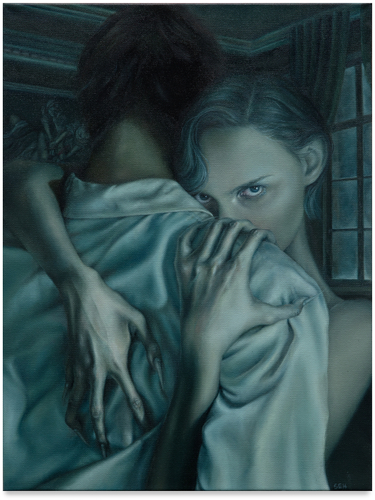
Sophia Huitema, Duplicity, 2026, oil on canvas, 24 x 18 in
American model turned self-taught artist Sophia Huitema moves fluidly between fashion and fine art, crafting a distinct visual world shaped by haze, mystery and intrigue. Her first solo exhibition with Harper’s in New York, titled Prussian Blue, encompasses seven oil paintings, all of which feature the Prussian Blue pigment. Through using solely blues and greens, she creates a world of her own – one where suspense is expected, interiors are dimly lit and the mood is both hazy and dreamlike. The focus naturally lands on Huitema’s cast of female figures, all watchful, and each with their own secrets, captivating the viewer’s very being.
Beyond the colour palette, Prussian Blue serves as a metaphorical throughline within her work. The pigment is produced through chemical reactions historically associated with cyanide, and it has also been used to treat specific types of poisoning – this juxtaposition between toxicity and protection is exactly what Huitema’s guarded and ambiguous figures embody. The sense of duality doesn’t end there; in fact, it ruminates throughout every aspect of her work. Huitema’s women, with their elongated limbs, slender necks and piercing gaze, haunt the viewer. The opulent, high-society, Gatsby-esque settings – complete with elegant gowns, pearl necklaces and jewel-encrusted headdresses – feel decidedly eerie, especially when washed in the murky blue palette. There is little reprieve from their intense presence; it is both calculatingly chilling and seductively alluring.
Drawing from historical and visual art references, Huitema’s figures are reminiscent of early 20th-century fashion illustration and Art Deco design, while the backgrounds lend themselves to Symbolism and Surrealism. Intertwined, these influences form an intentional contemporary visual language that speaks to Huitema’s singular artistry.
In conversation with Schön!, Huitema reflects on Prussian Blue and her first solo exhibition with Harper’s.
—
How does it feel to present your first solo exhibition with Harper’s?
It feels like exposing a part of myself that was never meant to be fully seen. At the same time, bringing this series to Harper’s felt like a necessary exhale. The work had reached a point where it needed to leave me, and there’s a clarity that comes with that. That clarity has allowed the work to exist outside of my internal world and step into a space where its silence can actually be heard.
What attracted you to Prussian Blue as both a pigment and a conceptual anchor?
I was drawn to Prussian Blue because of its duality. It was an accidental discovery that made a colour once reserved for royalty widely accessible, but it’s also the chemical parent of cyanide. It’s a colour that carries contradiction. It’s seductive, but also dangerous. That tension mirrors the figures in my work. They use desirability as a form of power; it’s their armour and their vulnerability all at once. They know what it means to be beautiful and lethal at the same time.
How did limiting yourself to a palette of blues and greens shape your expression?
The palette felt less like a limitation and more like a clarification. Working within it allowed me to focus more on atmosphere and tension rather than surface variation. When you strip away the distraction of a full spectrum, small shifts like light, gesture and form matter more. The colour becomes less of a choice and more of a condition the work exists within.
Your paintings have a moody, dreamlike quality. What is compelling about these dim, atmospheric interiors?
I’m drawn to spaces that feel like they’re holding their breath; compressed interiors, corridors, draped rooms deliberately composed to feel like a stage. The environments aren’t just backgrounds; they reinforce the figures’ internal states. Elements like curtains or mirrors place the viewer in an intrusive position. You’re not just looking at a painting; rather, you’ve entered a room you weren’t invited into.
There’s a strong sense of cinematic tension, particularly in ‘Sleeper Car’. How do you build suspense within a still image?
Suspense, for me, isn’t in the action. It’s in the moment just before or just after. Tension is built through what is withheld: Not in the motion, but in the stillness. It’s about that moment of realisation where the figure is no longer just being looked at, but is aware of the viewer’s gaze. There’s a kind of curiosity felt in return, but also unease. You want to understand what’s happening, but don’t want to be implicated in it. You’re left trying to piece together a story from fragments, without ever quite reaching a resolution.
The settings evoke glamour, but also unease. What made you place these figures in such an environment?
There’s a certain friction in high-society glamour that I find compelling. These settings are designed to be seductive – pearls, velvet, Art Deco opulence – but they don’t feel safe. There’s something unsettling about beauty when it starts to feel constructed or transactional. The figures hold a sense of control, but they’re also guarded in that they’re aware of being watched. They exist inside the tension of being a part of a beautiful image while trying to maintain an interior life that remains entirely their own—Amber Louise